

Software built on its specification.
The classic methods of software engineering, rebuilt for working with AI. Spec first, then tests, then code, reviewed and signed off by a human.
From an idea to verified software.
- Vision Goal, problem, architecture
- Microspecs Test scenarios with real values
- Build Agents build test-first
- Proof Review and security checks
- Sign-off A human signs off
Code has become cheap. Wrong code hasn’t.
A lot of people think software engineering is done: the AI writes the code, the rest will sort itself out. Coding agents really are faster than any human. Without clear guidance, though, they make a system worse piece by piece, and the worse the system, the worse the AI performs in it.
The remedies are old and proven: a precise specification, tests before code, a review against the requirements. SDD makes them the foundation the agents work from.
A specification, not a promise.
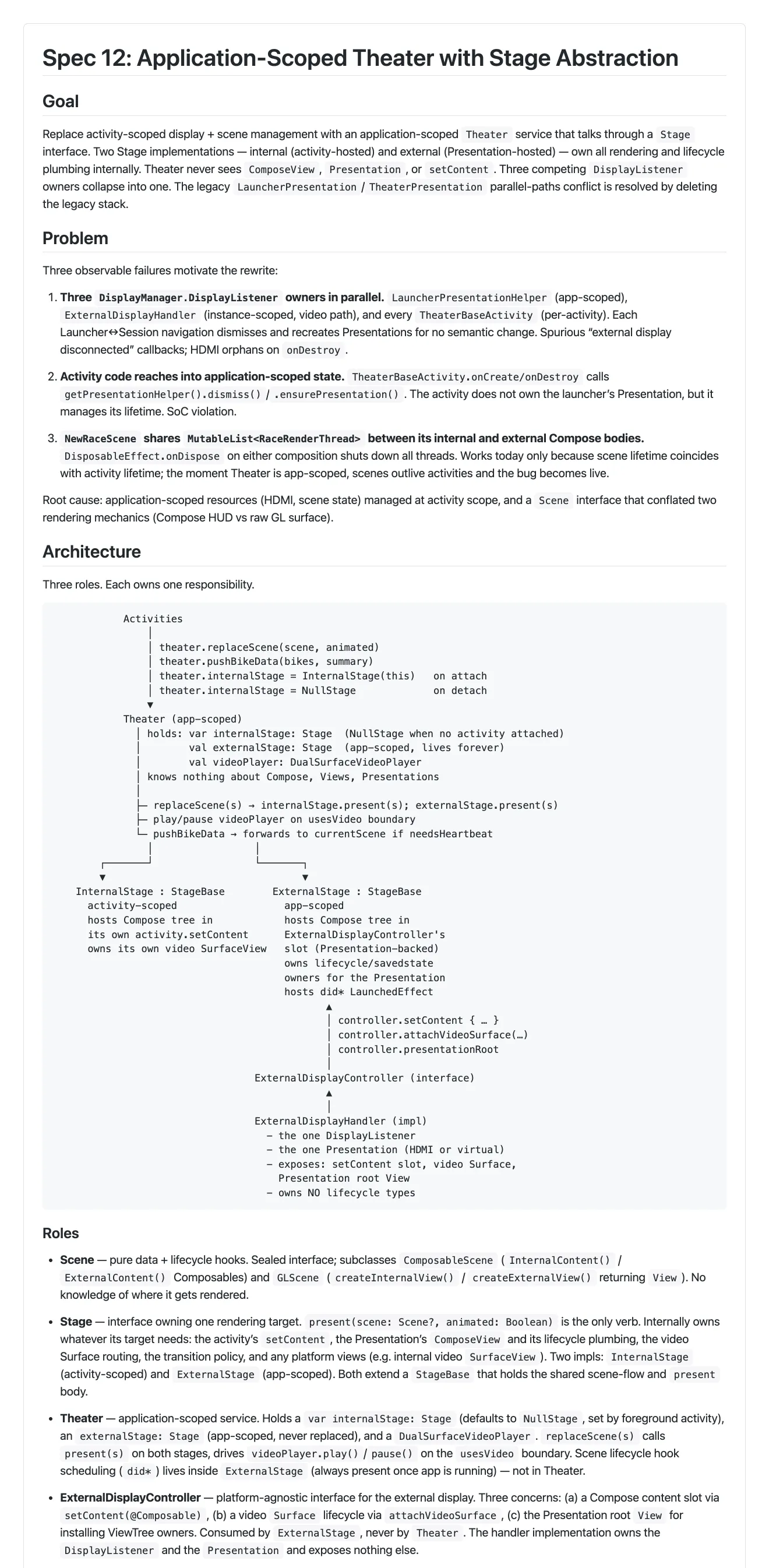
This is what my specs look like: the problem first, then the architecture, plus tests and acceptance criteria.
Where are you right now?
Most projects start at one of these four points. Regulation is part of every one of them: GDPR, the EU AI Act and the Cyber Resilience Act are designed in, not bolted on later.
A project has to ship.
I join your team as an architect or take over the whole project, with SDD from the first spec to production. If you like, the way of working stays with you afterwards.
- A spec suite and a running system
- SDD templates and a review process for your team
- How I work
The system is slow or hard to change.
An architecture review shows where it hurts, from the embedded device to the cloud backend. Then we optimize where it matters and modernize along a migration path everyone can follow.
- Architecture reviews for new and existing systems
- Performance analysis and optimization
- Legacy modernization, CRA compliance concepts
AI should come into the company. But where?
We work out where AI really adds value and where it doesn’t, and then build it: RAG, document pipelines or local models when your data must not leave the building.
- Opportunity analysis: where AI pays off and where it doesn’t
- RAG systems and LLM-powered business applications
- Local AI infrastructure, on-premises or EU cloud
The team uses AI tools without guardrails.
Hands-on training tailored to your stack, covering GDPR, the EU AI Act and data processing agreements in the depth day-to-day work needs. You end up with an AI usage policy your team actually reads.
- Team training from 90 minutes to a full day
- An AI usage policy for your company
- Materials you can reuse internally
Hi, I’m Andor Greißl.
I’ve been building software for 25 years. My longest-standing clients have been with me since my first year.
Since mid-2025 I’ve worked with SDD and the agent team, on my own projects and for clients. For example:
- Charging stations for electric cars
- Logistics with visible data flows
- Hundreds of fitness machines, analyzed live
- Software for law firms
- Processes for the Cyber Resilience Act
appdoo is my practice in Rosenheim, Germany. You talk to me directly.
You’ll find my code and tools on GitHub, and me on LinkedIn.
From the register to the prompt
- M68K-Assembler
- Specification Driven Development
- C++ Performance
- Demoscene
- Rust
- LLM orchestration
- Linux kernel
- Bare-Metal & RTOS
- Software architecture
- Driver development
- RAG & document intelligence
- OpenGL
- GPU rendering
- Geospatial data
- Android / AOSP
- iOS since 2010
- GDPR · EU AI Act · CRA
- Real-time visualization
- Local AI models
- Intralogistics
- Cloud architecture
- TypeScript
- Legacy modernization
- Self-Hosting
From the workshop
A project that deserves a clean specification?
Drop me a short note about what it’s about. In an intro call we’ll find out whether and how I can help. No strings attached, and the reply comes from me.